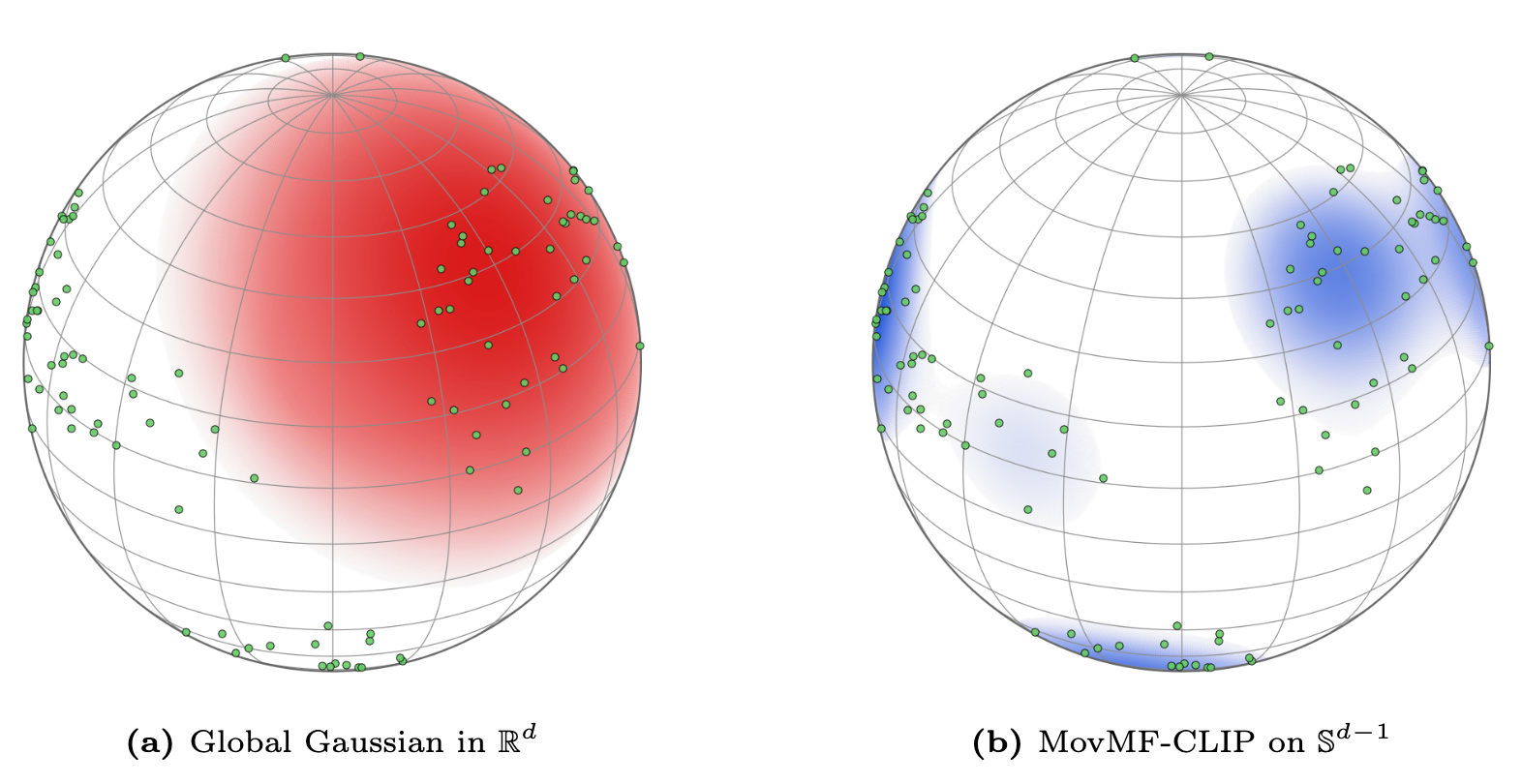
Contrastive Language–Image Pretraining (CLIP) representations form a semantic embedding space governed by cosine similarity, reflecting an intrinsic hyperspherical geometry. However, existing probabilistic interpretations typically rely on Gaussian assumptions, which fail to capture this directional and multimodal structure.
We propose a principled density model for the CLIP latent space based on Mixtures of von Mises–Fisher (MovMF) distributions defined on the unit hypersphere. Using the Expectation–Maximization (EM) algorithm, we efficiently learn a probabilistic model in which each mixture component corresponds to a coherent semantic concept. This formulation yields a closed-form likelihood naturally aligned with hyperspherical geometry, enabling accurate and interpretable density estimation.
Empirically, our model significantly improves long-tailed and out-of-distribution detection and provides a natural semantic decomposition, representing each embedding as a sparse probabilistic combination of interpretable concepts. These results suggest that CLIP latent space is more faithfully characterized as a hyperspherical semantic mixture rather than an isotropic Gaussian, establishing a simple and geometrically consistent probabilistic framework for modeling and understanding multimodal representations.
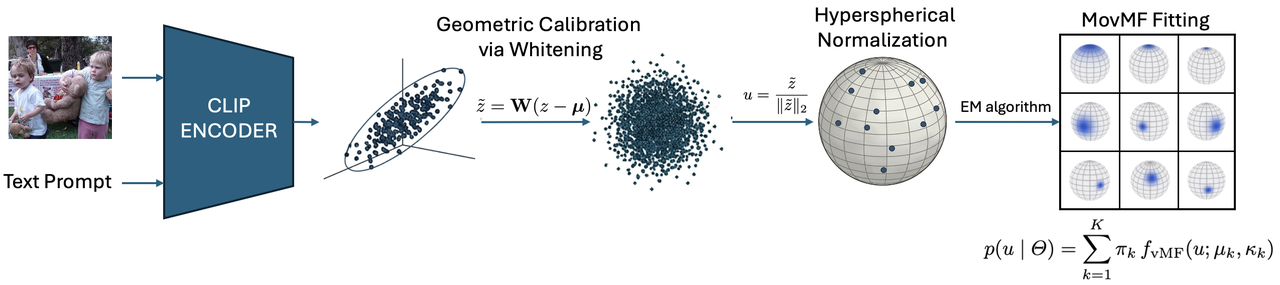
Upload an image to see its semantic decomposition and concept localization heatmaps based on MovMF-CLIP. The model decomposes the CLIP embedding into a sparse mixture of von Mises–Fisher components, each corresponding to a learned visual concept cluster.
@inproceedings{movmfclip2026,
  title     = {The Hyperspherical Geometry of CLIP Latent Space: A Semantic Mixture Model},
  author    = {Yu, Zijie and Liu, Gaowen and Kompella, Ramana Rao and Yu, Philip S. and Song, Yue},
  journal   = {ArXiv},
  year      = {2026},
  url       = {https://arxiv.org/abs/2607.13660}
}